
Dallas County Release Date Terms
Alabama uses several date labels that answer different questions. The Alabama Department of Corrections definition to use for a projected prison release is Minimum Release Date. ADOC defines it as the earliest scheduled date an inmate can be released to probation or end of sentence. It is a calculated date, not a promise. ADOC says the date can change if disciplinary action removes good time or if the circuit clerk sends new cases or sentence changes.
A Parole Consideration Date is separate. ADOC defines it as a tentative date set by the Parole Board. The Alabama Bureau of Pardons and Paroles says eligibility is calculated under Ala. Code Section 15-22-28(e), and that sentence, crime, jail credit, ability to earn good time, time served, and sentencing-court orders can affect eligibility. A person can reach a consideration date and still not be released because the Board can grant, deny, continue, reset, or take other action.
An end-of-sentence date is the point at which the sentence is fully served or discharged, subject to the controlling calculation. A county bond release is not a prison release date at all. It is a local release event tied to bond, a judge's order, a dismissal, time served, a transfer, or another county-jail reason. For Dallas County jail custody, the release record, bond record, and court order matter more than ADOC projected-date language.
| Date or Event | What It Means |
|---|---|
| Minimum Release Date | ADOC's earliest scheduled release to probation or end of sentence, subject to changes in good time, cases, and sentence data. |
| Parole Consideration Date | A tentative Board consideration date, not a guaranteed release date. |
| End of Sentence or EOS | The sentence-completion date after applicable calculation, credits, and lawful changes. |
| Mandatory Supervision Release | A pre-EOS release range for qualifying sentences under ABPP institutional parole-services rules. |
| County Jail Release | A local release from Dallas County custody by bond, order, time served, dismissal, transfer, or other jail record event. |
Find Dallas County Release Dates
A release date lookup should follow custody. If the person is still in Dallas County jail custody, use the Dallas County Jail Temporary Facility and court record. If the person was transferred to state prison, use ADOC while the person is still searchable as a current inmate. If parole or mandatory supervision is involved, add ABPP. If the person has already fully discharged from ADOC, the public ADOC search may no longer show the person because ADOC says historical data is not available online.
- Identify the custody type. Local arrest, bond, misdemeanor sentence, and time-served questions start with Dallas County jail and court records.
- For local custody, contact the Dallas County Jail Temporary Facility and ask for custody status, release date and time, release reason, and any transfer destination.
- Check the Dallas County court record through Dallas County Fourth Circuit Court information and AlacourtAccess when a court order, sentence, bond, or dismissal may control release.
- For state-prison custody, search ADOC inmate search by AIS number when possible, or by name with careful match review.
- Record ADOC fields exactly as labeled, especially minimum release date, parole consideration date, parole status, offense, sentence date, AIS number, and facility.
- For parole, mandatory supervision, or probation questions, use the ABPP Selma Field Office or ABPP public information channels.
- If the online search misses a released person, use VNS, court records, ABPP if supervision exists, or an ADOC public-records request rather than treating the miss as proof.
The current Dallas County official site does not publish an Alabama 24-hour or 72-hour release list, and no official Dallas County, Alabama sheriff app with release dates was confirmed in the research. That absence should be read narrowly. It means there is no public rolling web feed on the county site, not that release records do not exist.
ADOC Minimum Release Date
The ADOC definitions page supplies the correct vocabulary for state-prison date research. AIS is the Alabama Institutional Serial number and is unique to the inmate. A suffix may appear behind an AIS number. The minimum release date is the earliest scheduled release to probation or end of sentence. Parole status can mean currently on parole, declared delinquent, or revoked. These are state-prison terms, not Dallas County jail roster fields.
The public ADOC inmate search is also limited. ADOC says the database contains currently incarcerated inmates and historical data is not available online. A Dallas County felony defendant who has fully discharged from ADOC may drop out of the public search. Confirmation then moves to Alabama VNS if the person was a covered ADOC offender, ABPP if supervision exists, the court record, or an ADOC public-records request.
The ADOC definitions page is the source for the release-date labels used in Alabama prison records.
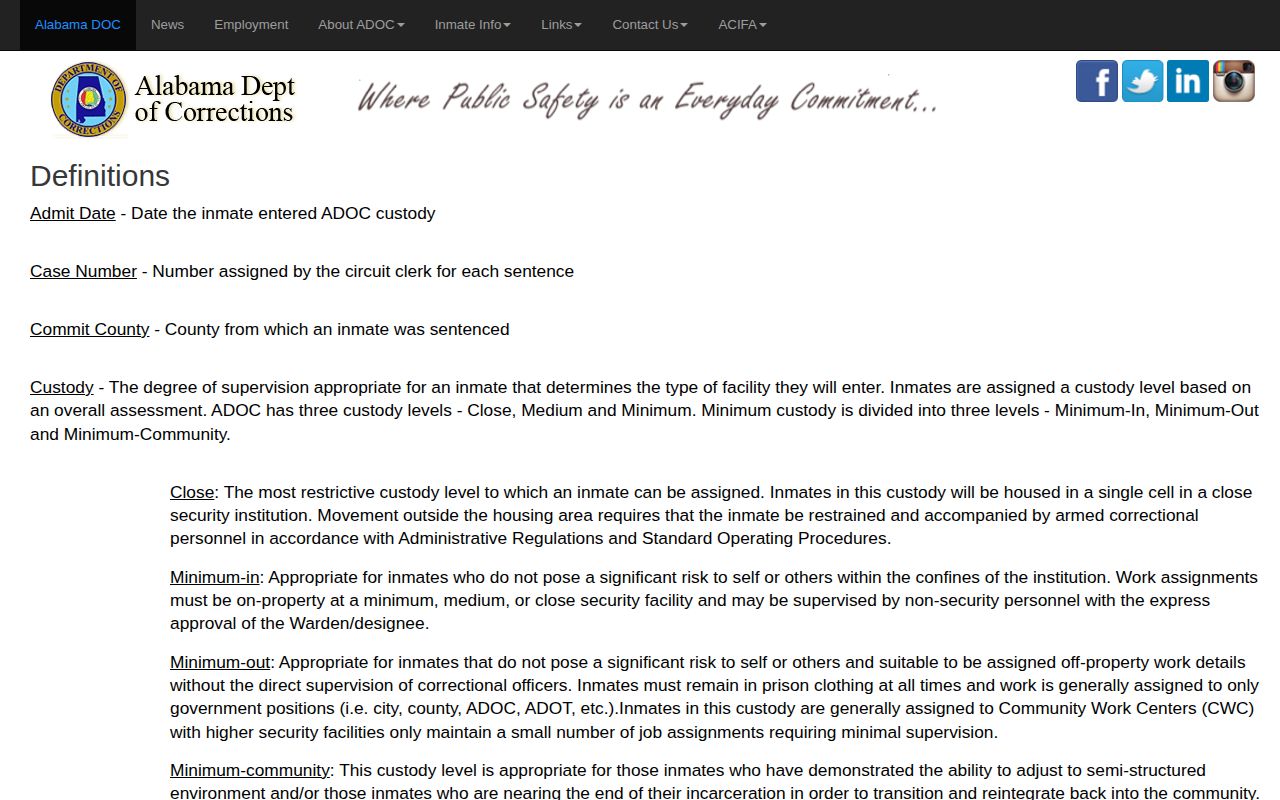
When a Dallas County case moves into ADOC custody, copy the date labels exactly. Do not rewrite a parole consideration date as a release date, and do not treat a minimum release date as the actual time of exit from a facility.
Alabama Good-Time Rules
Alabama correctional incentive time, often called good time, is governed by Ala. Code Section 14-9-41. Current public text shows four classes. Class I prisoners can receive 30 days for each 30 days actually served. Class II can receive 15 days for each 30 days served. Class III can receive five days for each 30 days served. Class IV receives no correctional incentive time.
The statute also lists exclusions. The research identified exclusions for Class A felony convictions, certain death-resulting crimes involving a deadly weapon, life sentences, death sentences, sentences of more than 15 years, and child sex offense categories. Because those exclusions depend on the offense and sentence, a Dallas County release date lookup should not assume good time applies. The correct method is to use the sentencing order, ADOC classification and calculation, any jail credit, and current ADOC or court records.
Good-time statute note: Section 14-9-41 can reduce some Alabama prison release calculations, but exclusions and class status mean there is no automatic subtraction that fits every person.
Good time can also be lost. ADOC's minimum release date can move if the person receives disciplinary actions that take away good time. A classification change can alter incentive-time earning. Corrected sentence data from the circuit clerk can also change the calculation. That is why a minimum release date should be saved with the date checked and then verified again near the expected release window.
Mandatory Supervision Date Ranges
Mandatory supervision is another reason Alabama release-date language can be confusing. The ABPP institutional parole-services page says sentences of five years or less have mandatory release no less than three and no more than five months before end of sentence. Sentences more than five years but less than 10 years have mandatory release no less than six and no more than nine months before end of sentence. Sentences of 10 years or more have mandatory release no less than 12 and no more than 24 months before end of sentence.
That range is not the same as parole granted by a Board vote. It is also not the same as a county-jail bond release. A Dallas County reader may see a parole consideration date, a minimum release date, a mandatory supervision range, and an end-of-sentence date for the same ADOC-sentenced person. Each points to a different legal event or calculation step.
| Sentence Length | Mandatory Supervision Range Cited by ABPP |
|---|---|
| Five years or less | No less than three and no more than five months before end of sentence. |
| More than five but less than 10 years | No less than six and no more than nine months before end of sentence. |
| Ten years or more | No less than 12 and no more than 24 months before end of sentence. |
No Universal 85 Percent Rule
Some release-date searches start with the phrase 85 percent because that number is common in federal or other-state discussions. The Dallas County, Alabama answer should be more precise. The research did not confirm a simple rule that all Alabama inmates serve exactly 85 percent. Alabama has sentencing standards and truth-in-sentencing terminology, but an individual release calculation depends on the sentence, offense exclusions, correctional incentive time eligibility, jail credit, mandatory supervision, parole-board action, and court orders.
The safest practical answer is to follow the Alabama sources. Use Section 14-9-41 for correctional incentive time. Use ADOC definitions for minimum release date and parole consideration date. Use ABPP material for parole eligibility and mandatory supervision ranges. Use the court record for the sentence imposed, jail credit, split sentence, probation terms, or later modifications. A single percentage cannot replace those records.
Why Dallas County Dates Change
A release date changes when the underlying legal or custody facts change. Some changes happen inside ADOC, such as a disciplinary action or classification change. Others come from the court, such as a corrected sentence, new case, amended order, or added jail credit. Still others are physical-release problems, such as a detainer or transfer that keeps the person from leaving custody even though one sentence has reached a release point.
| Change | Effect on the Date |
|---|---|
| Disciplinary action | Can remove good time and move an ADOC minimum release date later. |
| Classification change | Can change the rate at which correctional incentive time is earned. |
| Circuit clerk update | New cases, sentence amendments, or corrected sentence data can alter ADOC calculation. |
| Parole action | A hearing can be granted, denied, continued, or reset; a Board date is not a release guarantee. |
| Mandatory supervision | A qualifying person may have a pre-EOS release window, while exclusions can change the analysis. |
| Detainer, warrant, or transfer | Can prevent community release even when a jail or prison sentence reaches a release point. |
| Court credit correction | Jail credit or calculation changes can move the expected date earlier or later. |
Dallas County Jail Date Fallback
County-jail dates do not follow the same public ADOC field system. A Dallas County misdemeanor or local sentence may be affected by the sentencing order, jail credit, time served, bond posting, payment or release order, detainer, transfer, or another hold. No Dallas County public policy page was found that states a local jail good-time formula or weekend and holiday release rule. Do not invent one.
Use the local records path instead. Contact the Dallas County Jail Temporary Facility at (334) 690-1200 or dallascoso@dallascounty-al.org. Ask whether the person is still in custody, whether a release date and time has been entered, the release type or reason, the releasing authority, and whether the person was released to the public or transferred. If staff cannot provide details by phone, ask how to request the booking sheet, custody-status record, release record, bond record, court order, or transfer documentation.
The county jail page lists the temporary US-80 facility and Monday-Friday business hours. Because the original Selma jail building was damaged by the January 2023 tornado and news reports in 2026 described continuing displacement, physical release and property pickup should be confirmed with the current jail contact before travel.
ABPP Eligibility Source
The ABPP parole FAQ is the plain-language source for parole eligibility calculation. It states that ABPP calculates eligibility consideration under Ala. Code Section 15-22-28(e), using sentence, crime, jail credit, ability to earn good time, time served, and sentencing-court orders.
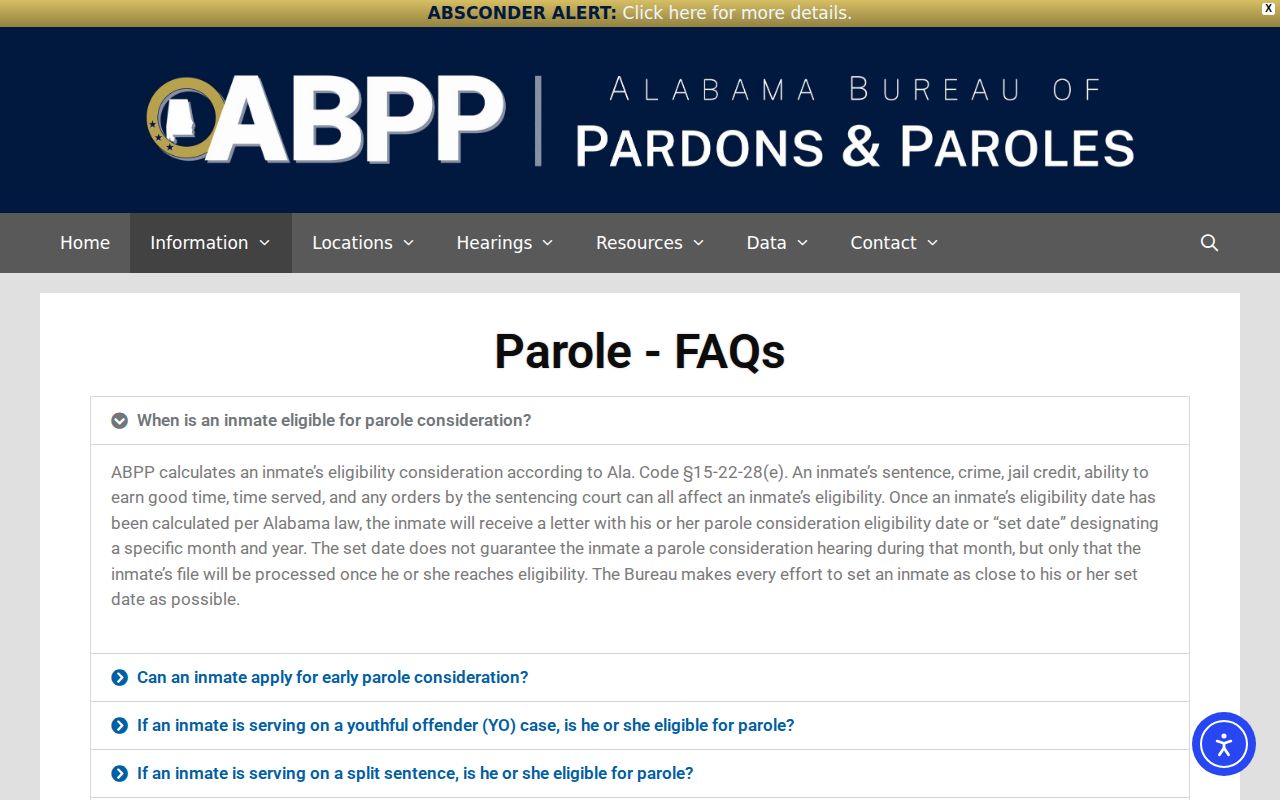
For Dallas County, ABPP's local supervision anchor is the Selma Field Office at 23 Broad Street, Selma, phone (334) 875-1074. Use ABPP for parole, probation, mandatory supervision, delinquency, revocation, hearing schedule, hearing results, and people granted parole but not yet physically released. Use the court record for sentence terms and later court orders.
Official Release Date Links
Release-date work is more reliable when each source is used for its own custody lane. Dallas County jail records answer local release questions. ADOC answers current state-prison custody and minimum release date questions. ABPP answers parole, probation, and mandatory supervision questions. VNS and VINELink can support notifications for covered events.
- Dallas County Jail Temporary Facility
- Dallas County Sheriff's Department
- ADOC Inmate Search
- ADOC Definitions
- ADOC Public Records Request Form
- ABPP Parole FAQ
- ABPP Selma Field Office
- Alabama VNS
- VINE Inmate Check
Note: For a person already released from ADOC, the public current-inmate search may not hold the historical record online.