
Parole vs Probation in Dallas County
Parole and probation both involve community supervision, but they start from different legal events. Parole usually follows a prison sentence and a decision or release process involving the Alabama Bureau of Pardons and Paroles. Probation usually comes from a sentencing order entered by a court. In Dallas County, the same local ABPP field-office network can be relevant to both, but the proof source is not identical: parole is checked through ABPP hearing, status, and supervision channels, while probation should be matched against the Dallas County court record that imposed or modified the sentence.
| Supervision term | How it begins | Best verification source |
|---|---|---|
| Parole | After ADOC prison custody or parole-board action, subject to release processing and conditions. | ABPP hearing schedule, current-year results, hearing minutes where posted, Public Information Unit, and local field office. |
| Probation | By court sentence, split sentence, modification order, or revocation-related order. | Dallas County Circuit/District Court records through the clerk or Alacourt, then ABPP Selma Field Office for reporting logistics. |
| Mandatory supervision | Through Alabama release rules before the end of certain prison sentences. | ADOC records for custody/release dates and ABPP for supervision status if supervision is active. |
| End of sentence | Sentence expires or is discharged after applicable credit and orders. | ADOC, court, or jail records depending on the sentence source; ABPP only if supervision remains or a status question exists. |
How to Verify Dallas County Supervision
Start with the reason the person was released. Dallas County does not publish an official Alabama jail roster, 24-hour release feed, 72-hour release feed, or booking-photo release list on the county site. For a county-jail release, call or write the Dallas County Jail Temporary Facility first, then use the court record to determine whether the release was bond, time served, dismissal, transfer, probation, or another court order. For a state-prison release, use ADOC, ABPP, and Alabama VNS/VINELink channels because the county jail may only show that the person was transferred away from local custody.
- Confirm the release source. A person released from the Dallas County Jail Temporary Facility at 4805 US-80 is different from a person released by ADOC after a prison sentence.
- Search or request the court record. Use Alacourt or the Dallas County court/clerk channel to look for a probation order, split sentence, revocation order, sentence credit, bond order, or disposition.
- Check ABPP if the record points to parole, probation, mandatory supervision, revocation, or supervision reporting. The ABPP field-office-by-county list places Dallas County under the Selma Field Office.
- Use ABPP hearing pages for parole-board action. A parole grant, denial, continuance, reset, or hearing-minute entry is not the same thing as a county jail release record.
- Use Alabama VNS or VINELink for covered notification events. Alabama VNS is for offenders convicted in Alabama and sentenced to ADOC custody; Dallas County pretrial jail questions should still go back to the sheriff, jail, and court.
- When online sources conflict, ask the record owner to confirm the field. Jail, court, ADOC, ABPP, and ALEA records can each control a different part of the same person's history.
Selma ABPP Field Office
Dallas County has a local supervision contact through the Alabama Bureau of Pardons and Paroles rather than requiring every ordinary reporting question to begin in Montgomery. The official Selma Field Office page lists the office as serving Dallas and Wilcox counties. That local detail matters for a Dallas County releasee under ABPP supervision, but it should be read as a verification and reporting contact, not as evidence that every released person is on parole or probation.
23 Broad Street
Selma, AL 36701
Phone: (334) 875-1074
Fax: (334) 875-0803
Hours: Monday-Friday, 7:30 a.m.-6:00 p.m.; closed state and federal holidays
Counties served: Dallas and Wilcox
Use the Selma office for local reporting-office questions, supervision-location confirmation, and direction after a Dallas County person has been placed under ABPP supervision. For questions about an upcoming parole hearing, a grant where the person has not yet been released, or a missing or passed consideration date, ABPP's Public Information Unit is the better starting point because it works with the Docket Unit and Revocation Unit on those statewide issues.
The official ABPP field-office page is the relevant source for this local contact:
Because the office serves more than one county, be precise when calling: provide the person's full name, AIS number if known, date of birth if appropriate, Dallas County case number if the question is probation-related, and whether the issue concerns parole, probation, mandatory supervision, or a possible violation.
Parole Hearings and Results
Parole hearings are statewide board events, not Dallas County courthouse hearings. ABPP's general hearing information says parole and pardon hearings are held in open public meeting each week on Tuesday, Wednesday, and Thursday unless otherwise noted, at 301 South Ripley Street in Montgomery, with waiting rooms opening at 7:30 a.m. The scheduled parole hearings page should be treated as the current calendar because cancellations and docket changes can occur.
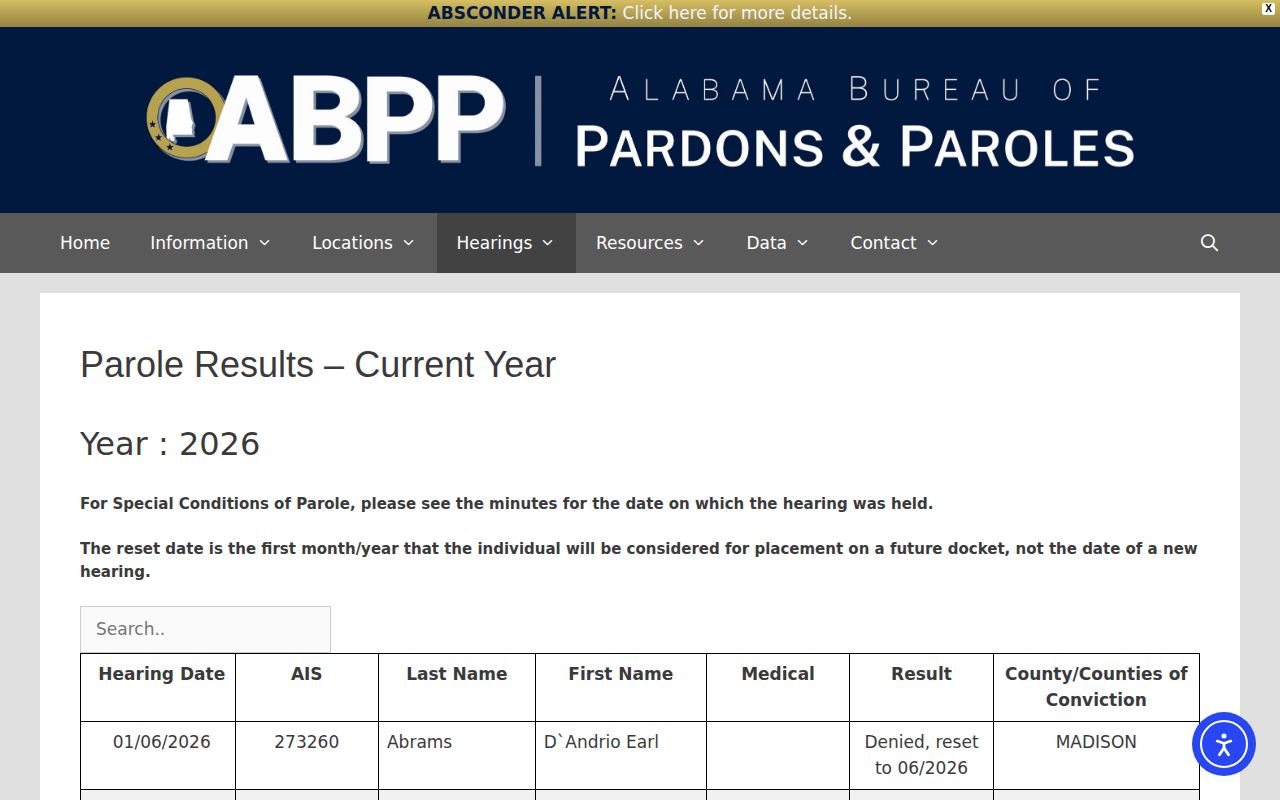
ABPP also publishes current-year parole results and a hearing-results archive. Result language has specific meaning. A grant means the Board approved parole, but physical release may still depend on release processing and conditions. A denial means parole was not granted. A continuance moves the matter. A reset date is not a new hearing date; ABPP describes it as the first month and year the person can be considered for future docket placement. Hearing minutes, when posted, may include special conditions or more detail than the summary list.
Eligibility should not be reduced to a single simple rule. ABPP's plain-language eligibility guidance says parole consideration is calculated under Ala. Code Section 15-22-28(e), considering the sentence, crime, jail credit, ability to earn good time, time served, and sentencing-court orders. ADOC's vocabulary also matters: a minimum release date, parole consideration date, end-of-sentence date, and mandatory-supervision release are different concepts. For a Dallas County case, match the ABPP result to the ADOC record and to any Dallas County sentencing order before concluding what supervision exists.
ABPP posts are the correct source for parole-board action:
For someone granted parole but not yet physically released, use the Public Information Unit routing rather than assuming the person left custody on the hearing date. ABPP specifically separates questions about granted parole not yet released from general upcoming-hearing questions.
VINE and VNS Supervision Alerts
Alabama has two notification paths that can touch post-release supervision: VINELink Alabama and the Alabama Victim Notification System. VNS is limited to offenders convicted in Alabama and sentenced to ADOC custody, and it directs pretrial-case questions to the sheriff in the county where the crime occurred. That limitation is important in Dallas County because a person may leave the local jail on bond or a court order before any ADOC sentence exists.
For covered ADOC/VNS events, notification channels can include custody-status changes, parole or pardon hearing activity, mandatory-supervision release, medical release, furlough or leave, end-of-sentence release, and other status updates. VINELink can be used as a person-specific check and notification-registration channel, but a no-result response should not be treated as proof that a Dallas County jail release did or did not happen. Use VINE/VNS as one confirmation layer, then reconcile it with jail, court, ADOC, and ABPP sources.
Conditions, Violations, and Absconders
Supervision conditions are case-specific. They may include reporting, travel limits, program participation, treatment, restitution, fee payment, contact restrictions, residence approval, testing, or other requirements set by the Board, the court, or the supervising agency. Public sources may show that supervision exists or that a hearing occurred, but they may not disclose every condition in a supervision file. When minutes or court orders are available, use them as the public source rather than guessing at a person's terms.
Absconder, delinquency, and revocation are supervision terms, not ordinary release terms. Alabama Code Section 15-22-32 addresses parole violation, delinquency, and revocation procedures. ADOC's parole-status definition includes statuses such as currently on parole, declared delinquent, or revoked. In practice, that means a person can be released from prison custody but later have a supervision problem, a violation report, a delinquency declaration, a revocation proceeding, or a return to custody.
| Term | Practical meaning | Where to verify |
|---|---|---|
| Absconder | A supervision term commonly used when a person fails to remain available to the supervising authority. | ABPP or court process; do not rely on rumor or outdated third-party copies. |
| Delinquent | A parole-status term tied to alleged noncompliance or violation handling. | ABPP status channels, Public Information Unit, or official revocation records where public. |
| Revoked | Supervision has been revoked through the applicable process, which may return the person to custody. | ABPP revocation information, ADOC custody record, and the court record if probation is involved. |
| Warrant or hold | A separate custody or court issue may prevent release or cause a later arrest. | Dallas County court, sheriff/jail, ABPP, ADOC, or the issuing agency depending on the hold. |
How Dallas County Supervision Ends
Supervision can end by discharge, expiration of the sentence or supervision term, court order, Board action, revocation and later custody processing, or correction of a record that showed the wrong status. The right confirmation path depends on which agency controls the record. For a Dallas County probation sentence, the court record is central because probation comes from a sentence or order. For an ADOC parole or mandatory-supervision release, ABPP and ADOC records carry the key status and discharge information.
Do not assume that a person has no supervision simply because they no longer appear on a current jail roster or current ADOC search. ADOC's public inmate search is focused on currently incarcerated inmates and says historical data is not available online. A fully discharged person may require an ADOC public-records request, a court record, ABPP confirmation, or VNS/VINELink history if registration existed. For county-jail matters, a release record can show that someone left Dallas County custody, while the court file explains whether probation, a future hearing, or another case condition followed.
If a supervision record is wrong, identify the record owner before asking for a correction. The jail or sheriff controls booking and local release fields. The Dallas County Circuit Clerk and court records control dispositions, sentencing orders, probation orders, and revocation orders. ADOC controls prison custody-history records. ABPP controls parole, probation-supervision, hearing, and revocation records. ALEA controls state criminal-history and registry data. Alabama's Title 41, Chapter 9, Article 23 provides a criminal-record correction framework, while expungement is a separate court process under Title 15, Chapter 27; ALEA says an Alabama court grants expungements, not ALEA.
For public-records follow-up, keep requests narrow and factual. Ask for the public hearing result, discharge date, supervision status field, probation order, revocation order, custody-history entry, or release/discharge record that matches the agency's role. If the answer affects a Dallas County release question, reconcile the final response with the local jail release record, the court file, and the ABPP or ADOC source that created the supervision status.